Duration of the Learning Session: The Science topic for a week – 5 days with 45 minutes session everyday
Analysis of Learners:
Target learners are prekindergarten students – ages 4 – 5 years old in a learning center of urbanized communities. Learning styles of the students are auditory, visual and kinesthetic or a combination of two. Visual learners will remember information best when presented with pictures or graphics, while auditory learners at this stage are more likely to prefer listening to stories or telling stories as a way to understand information. Kinesthetic learning styles learn best by manipulating objects and engaging in physical activities to learn the material.
Learners at this stage are beginning to develop greater independence, self-control and creativity. They have greater attention span and are curious, inquisitive and are eager to try new things. Their vocabulary is growing, as with his or her thought process. The learners can follow two or three part commands and are able to answer simple questions easily and logically. Most learners at this age enjoy singing, rhyming, and making up words. They are energetic, silly, and, at times, rowdy and obnoxious.
The learners may have previous preschool/day care experience while others are new to school set up. Learners are enrolled in a preschool class as preparation for kindergarten or formal education.
State the Objectives
After a week’s lesson about plants around us, the young learners would be able to:
- Demonstrate understanding of the topic by a) naming the four different parts of a plant; b) Identify what is needed for plants to grow; c) Recognize the common uses of plants in everyday life
- Discuss and perform different learning activities together with peers that shows collaborative learning, self control and longer attention span
- Follow independently two or three part instructions and communicate observation to the class
Cognitive
Through using their senses – touch, see, smell, hear and taste, learners are observing, exploring and discovering among other things. When learners observe the different plants around us, experience planting the seeds and conduct an experiment in growing plants they are experiencing process skills of observing, comparing, classifying, measuring, communicating, inferring and predicting. These science process skills are the foundation for the processes required to appreciate and understand more complex science in later years.
Affective
The stimulating and play based learning activities like reading stories, singing combined with exploring actual plants and seeds and planting experience provides provocation for the student to listen attentively and actively participate. Together with the teacher and peers, the student is engaged in collaborative learning that shows self control and longer attention span. With the different group activities, the learners’ social skills like taking turns and sharing exhibits their ability to control their emotions.
Psychomotor
The young learners are active participants in both exploration and discovery. Upon gathering the data through their senses, each will accomplish their individual task and group activities with minimal assistance from the teacher. The learners will plant their individual seed by listening to the teacher’s instruction. Learners can use creative ways like through art, chart, and journal to communicate their observations.
SELECTED METHODS, MEDIA AND INSTRUCTIONAL MATERIALS
Prepare the Environment
The lesson will use appropriate play based and inquiry based learning and follows progressive educational approach for early childhood development. The 5E Instructional Model of engagement, exploration, explanation, elaboration and evaluation will also be utilized for this Science lesson. Assessments will be done for the purpose of improving learning outcomes and experiences. The assessment procedures to be used are direct observations, performance based assessments, work sampling portfolio, journaling and teacher’s anecdotal notes. To make this first lesson in plants engaging and hands on, different types of media such as printed books, video projection, audio materials, models and real objects will be utilized. Visual projected material like MS Powerpoint presentation will be needed to present the experiment results. Non-projected display materials like whiteboards and graphic instructional materials for the activities for chart making and matching activities and games, and still pictures of different parts of the plants, flowers, seeds and gardens are also included to facilitate the lesson. The instructional materials used will involve the use of all senses- sight, smell, hearing, touch and taste for effective Science learning.
UTILIZED MEDIA AND INSTRUCTIONAL MATERIALS
Preview the Material
The teacher will conduct local research of the common plants and flowers growing in the area and the different kinds of seeds (with fast growing seed like mungbean) and conduct online research of the following: 1) age appropriate books, songs and short videos, 2) high resolution still pictures of the different parts of the plants, seeds, flowers and gardens.
Prepare the Material
For real objects- look for sources of a. plants (6 kinds of plants mungbean, onion or carrot, ampalaya, tomato, rose and mango b. seeds ( 6 kinds- mungbean, corn, rice, squash, avocado, and sunflower) c. flowers (sampaguita, gumamela, ylang ylang, everlasting, santan). Call the local garden and flower shops and ask if they are willing to donate or give a discount for some plants, flowers, seeds and gardening materials like soil and pots.
Ready the printed, audio and video materials together with the projector, computer and speaker. Non-projected display materials like whiteboards, graphic instructional materials and still pictures should be printed in advance. Powerpoint templates should also be ready in advance for easy updating. All materials should be arranged in different boxes that reflect the day they will be used and labeled Day 1, Day 2, Day 3, Day 4 and Day 5. The model material should be in the box when it will be used.
The classroom will have a corner for circle time, and three tables that will be used for table activities. The sensory table and table with soil tends to be messy so teachers should have a tarp underneath. There should be enough space for the students to work in each table and space to move from one table to another.
Preparation of teaching assistants win the different activities and learning objectives is important. The young learners should be allowed to express his or her observation regarding their experience.
Prepare the Learner
The young learners are natural scientists, born to explore and make sense of things around them. The teacher and the teaching assistant should always encourage the child to find ways to connect, explore and experience the activities. Though messy play is good, involve the child in the cleaning up process to build good habits.
Provide the Learning Experience
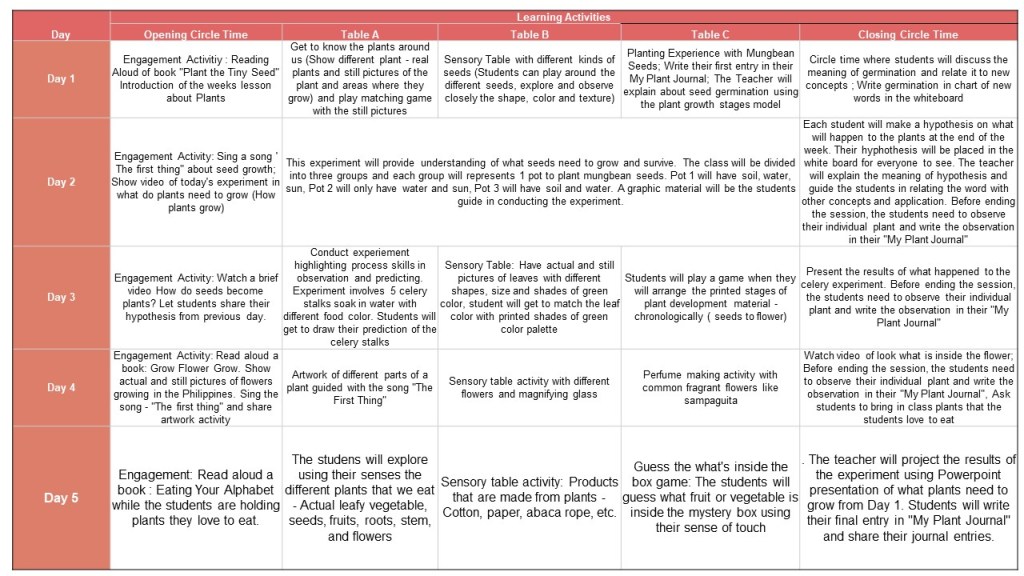
The lesson will start following the class routine of Circle Time and table activities and exercises. Each day, the class will be divided into 3 groups. Each group will have a table with corresponding activity that the students will conduct in ten minutes. Every student will have the opportunity to explore and accomplish the different table activities and exercises. The activities are fun, with different hands on activities and experiments that will provide the students to practice different process skills. Prompt critical thinking by asking open ended questions. Encourage all kinds of answers. The daily learning activities are in the table below.
REQUIRE LEARNER PARTICIPATION
The use of 5E Instructional Model based on constructivist learning theory can be considered best practice in Science teaching. This approach uses a learner center and hands on activities that are reflected in the instructional plan. Engaging activities start the lesson that enhance learner participation and experience. There are also play based and sensory activities in the plan that can encourage the learner participation.
EVALUATION AND REVISION
Instructional materials and media resources that will be utilized help achieve the learning objectives. Age appropriate teaching and learning approaches help facilitate learning and enhance student participation. Real objects like plants, seeds and flowers that students can manipulate and explore using their five senses help learners experience process skills for preschool Science concepts.
The non traditional assessments that will be used are direct observation/anecdotal notes, performance based assessments, portfolio and journaling. Each student will have a “My Plant Journal” that reflects the students observation in the activities and experiments. A rubrics for grading performance based assessment will also be used.
The art project demonstrating the knowledge of the different parts of a plant will be included in the student’s portfolio that can also reflect the students fine motor skills and creativity. The teacher and teaching assistants will write anecdotal notes of each student’s performance in self control, attention span, collaborative learning, ability to follow two to three part instruction and critical thinking skills.
 Charry's Teaching Odyssey